Friday, October 22, 2010

Adam's Thought on Ikiru by Akira Kurosawa

I originally screened Ikiru by Akira Kurosawa in 2004. I was 16 years old. I will be telling you why I chose the film, why I fell in love with it, and why it's one of my all-time favorite Kurisawa films. We've all been there, question our existence and our very mortality, wondering if tomorrow will ever come. I found myself thinking this in the year 2004, a very turbulent time in my personal life. I was changing schools, having to meet knew people, and was subjected to quite a few medical issues (I'll spare you the details). Essentially, I found myself wondering at such a young age the meaning of life, and if I knew my "expiration date," what I'd do.

Whenever I see a film, I always try to find a way to connect it with my own life. This comes easier to some films, and harder to others. I saw Ikiru in the Spring of 2004 (April). I felt a deep emotional connection with it, wondering how I would feel if I put myself in Mr. Watanabe's (our protagonist) shoes. If I had wasted the last 30 years of my life in a bureaucratic job, how would I feel knowing that my ultimate demise was impending? Granted, being 16 years old at the time I had not experienced such a lackluster lifestyle that Mr. Watanabe had, but I found myself still asking what I would do. What does Watanabe have? Solely his job. His family is only concerned with how much money they will gain from his inheritance. He has his papers at his desk and nothing else. When Watanabe meets the gentleman at the bar, he finally begins to live. He goes out to night clubs, bars, and the like and lets himself be free. This is where my second favorite scene of the entire film occurs. When Watanabe is inside the dance club, he requests that the piano player play a solemn Japanese pop hit from the early 1900's. It is here that everyone is taken aback by Watanabe singing the lyrics. The look on his face says it all: no matter how much he tries to forget he has terminal cancer, he cannot get away from it. Alcohol only masks (and worsens) his problem. Dancing and being free are only temporary reliefs. The fact of the matter is, he will die, and he has frittered away a third of his life stamping papers. This scenes is haunting to me because it seems to me that he finally realizes he cannot get away.

Side note: I also enjoy the film because it speaks out against bureaucracy (one of my sore spots). The work Watanabe is doing is meaningless. He has lived his life at a desk with an ink pad and stamp in hand. He was simply a cog in a machine all these years, and thanks to the monotonous monster known as bureaucracy, he has led a worthless life. What's worse is that he is constantly reminded of it when he goes home by his certificate of appreciation for years of hard work.

I felt that the interaction he had with the enthusiastic young lady from his office is also very important. Watanabe obviously had never had the sort of interaction he had had with her before. She offered him a sense of hope. Perhaps in the time he has left, he can see life in the way that she does: carefree, enthused, and full of vivacity. It's also very important to note that she is poor, yet she loves life so much. Watanabe realizes that no matter how much money he has, he has always been miserable. Watanabe wonders, "If this young lady can live her life without money to it's fullest, why can't I?" Money can't buy happiness. Watanabe starts to realizes all of those things he took for granted while being cooped up in his office, like sunsets.

Watanabe's death was important. It served as a wake up call to all the other employees in his office. The employees also realize that by sending people around to other departments, they're wasting the other people's lives, too. The second to last scene at the mourning of Watanabe's death is not only my favorite in the film, but my favorite of almost every movie I've ever seen because of the harsh realization the employees come to.

The brevity of life is the meaning of the film. Ikriru (in English, "To Live") is a film that made me personally take a step back and remember to not take anything for granted. I hope that anyone who views this film can have a sort of trans formative experience, connect the film with your own life, and remember that life is brief.

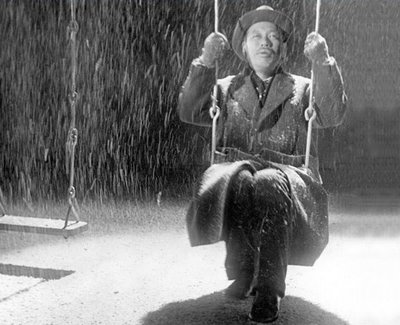
Thursday, October 21, 2010

Brian Hammons' thoughts on Ikiru

I rather liked this. I've seen at least ten Kurosawa films previously, mostly samurai stories, and while I was always fascinated by his aesthetic touch (a visual from Ran (1985) ran through my head the other day) I've never had any sort of deep, emotional resonance with his films. Ikiru is on many "best of all-time" film lists which was reason enough for me to have it on my radar, that being said I was glad to have the opportunity to view it afforded to me via my participation in this club.

Back to the idea of having a personal connection to the material, this story certainly appeals to the human condition, and ultimately asks us to grapple with our own questions of mortality, etc. What kind of decisions do we want to make, or digging deeper, what kind of impact would we like to leave behind? Both fascinating and patently deep, complex questions we may find ourselves grappling with one day.

In terms of sheer moviemaking thoughts, Takashi Shimura truly floored me with his performance as Kanji Watanabe. I actually found most of the acting in the film uniformly strong, but his portrayal of a dying man had such gravitas and depth that it clearly stood out. I know it'll be lodged taking up residence in my own head for a long time. Kurosawa directed with a confidence and assuredness that gives the film real weight. His use of transitioning between different points of time strengthened the tale.

If I were to come up with any negative things to say about it, there'd be very little I could come up with immediately. I would say I enjoyed the first two-thirds or so the most, the last act of all the other government officials getting drunk and reminiscing and philosophizing certainly had its point but after while started grinding for me. It did go to show, near the end, that faced with the same opportunity to do good, they couldn't muster the inner-strength and courage to break tradition and make a moral stand the way Watanabe had.

I just love the idea of this "mummy" cocooned in piles of paperwork for nearly thirty years wanting, if just for one day, to live life to its fullest and embrace every moment.

Film #13: Ikiru (1952)


Ikiru (生きる "To Live"?) is a 1952 Japanese film co-written and directed by Akira Kurosawa. The film examines the struggles of a minor Tokyo bureaucrat and his final quest for meaning. The film stars Takashi Shimura as Kanji Watanabe.

Sunday, October 17, 2010

Jessie's Thoughts on Eyes Without a Face

Well a most unique entry and served it's purpose of being a film I personally wouldn't have chosen myself or had heard about be it not through this little group. Not sure where to start, maybe I'm in the minority here but this didn't feel so much to me a horror movie, sort of in the same vein as Let the Right One In. Yes, there's murder, disfiguration, strange occurrences, but sort of feels like a story revolving around one central character and the strange lifestyle she's trying to deal with. I like how Daryl put "Christiane moves around her house like a ghost", in every sense of the word he's right. She has no life, her call to Jacques breaking the unwritten laws of her new existence while awaiting her new face. Even then, Christiane is gone, in spirit as much as name and body.

Her father is an interesting aspect of this film, as on the surface his motives seem noble, loving even, he wants his daughter to live on, with a whole face and body, no matter how he must achieve it. But once the movie starts getting deeper, it's obvious to everyone watching her life is miserable waiting for this new persona, and she has no will to go on like this. You don't see much face time between father and daughter either, as if just to do it is the payoff for him, he is more concerned about recreating what he did for Louise than really talking to his daughter about how she feels about it. I actually thought the ending made sense, and was happy with it, you were right though boss, Louise died with such poise, it was a strange scene.

I'm not sure ipulled some of the profound messages Geo was referring to while watching it, but i suppose you could, nonetheless it's a surprising movie because you may think one thing (as I was inevitably thinking this would be a more sophisticated version of freakish 80's horror film from my youth, "Pieces" and i guess it kind of was) but actually the filmmakers did have something in mind more than just baseless horror.

Friday, October 15, 2010

Dspang's Thoughts on Eyes Without a Face

Lets give it up for Edith Scob!!! Man o' man. I'm not too sure about her earlier output but she was all over this movie. Talk about having a tough challenge. She's given a role where there aren't many lines and the only way she can communicate is through her eyes and her body language. Every time she was on screen, despite her mask, I was enraptured. She moved like a ghost through the house. Her eyes, damn, I've never seen more expressive, more deeply emotional eyes in a movie for a long time. Her whole role was almost ethereal. Loved it. When we got to see her face grafted, she was absolutely beautiful. Excellent performance.

It seems the running theme in this movie though was of sight and the eyes. Less so about actual appearances. There were so many moments where there were close-ups on character's eyes. Even in black and white the women in this movie all had beautiful eyes. I think this movie had a lot to do with having to see things every day that maybe you didn't want to see. The one girl in the movie didn't really want to see Christiane's deformed face, and it horrified her. Christiane had to witness as her father and Louise murder girl after girl in order to save Christiane. Here we have horrible things going on right in front of our eyes every day and we often fail to see them. We look away. That was an underlying message I often felt this movie was giving out. The one point when Christiane wished she was blind. I can see that as metaphorical. Not only did she not want to see her face, but her face in a way was also serving as a reminder of the horrible acts being performed in her name. I found myself shedding a slight tear every time Christiane picked up the phone to talk to Jaques. That was heartbreaking. The sense of longing in her eyes. You don't see much acting like that anymore.

Then we have Dr. Genessier. In a way he had a moral obligation to Christiane. He caused the bulk of her pain and suffering with his wanting to control everything. I can understand the considerable guilt he was feeling. But we can't forget that he is the villain here. This is a man so convinced of his abilities that he feels that he can save anyone despite the time period's technology. Its cliche to mention the god-complex for the millionth time but this movie referenced it a lot better than anything having to do with genetics has in the past.

By the end of the movie you can just tell that Christiane has lost all hope. Its in her eyes. A weariness that sticks out quite well. The doctor's death is quite befitting to him and seems to have a slight reference to Frankenstein in that his creations or experiments turned on him. In a way Christiane was his biggest experiment. His longing for control of everything seemed to consume him more than his love of his daughter. By the end of the movie I felt that he was just grafting faces to see if he could successfully do it.

All in all this movie is fantastic. This is my second viewing of it and all of this movie shoots back to a time when movie-making was a lot more simple. Excellent.

Thursday, October 14, 2010

Brian Hammons' thoughts on Eyes Without a Face

I was excited to see this as it sort of killed two birds with one stone given my current interests in film. When tackling the grueling task of watching all the "great" movies of all time (which I'm currently embroiled in), it's difficult to pinpoint a good "jumping in" spot, so lately the bulk of my film viewing has been from the decade of the '50's; thankfully, this film (depending on your sources, some date it as being from '59) and the next selection (Ikiru) are both from that decade. Also, I've developed a bit of an affinity for French film, in fact our logo graphic on this blog is a snapshot from Godard's spellbinding masterpiece Pierrot le fou which still invades my thoughts every so often.

I watched a sizable portion of this in the library on my laptop. The juxtaposition of the eerie, stark black and white photography, and general creepiness of the film contrasted to the bright colors and smiling, young faces of passerby. I think a big misconception at the film, given our current sensibilities, is to equate it to the exploitation fare comparable to Saw and its legion of sequels, but that'd be doing it a real disservice, I found it much closer to works of great German Romantic fabulist E. T. A. Hoffman, or perhaps even a more sinister, fatalistic Brothers Grimm tale. It really is poetically perverse.

Some other misc. thoughts: I absolutely loved Edith Scob's (as Christiane Génessier) eyes in the dinner scene, so expressive, full of such emotional depth, her "face" having to convey so much where not a lot is actually said, just a stunning bit of acting and probably my favorite moment. A funny little thing is the "theme" so to speak that plays several times during the film I recognized right away from the hilarious HBO series Curb Your Enthusiasm, I'm not sure it was intentionally lifted from a forty-year old Franju film or if its a more common piece of music but given the two completely different contexts its used I couldn't help but grin. Louise referred to Christiane as angelic at one point, which she sort of did appear like towards the end, freeing the animals, a savior so to speak to the would-be tortured experimental specimens. I thought Louise's death was sort of hokey, she took a scalpel directly into her throat with more poise and class then I did when I received my degree at college graduation. I liked this, good pick Darrel, don't know that I'd call it top-shelf '60's horror and/or French work, but its certainly a fun watch and will leave some mental mementos behind in my mind. I'm looking forward to your third selection next round -- I'll be sure to have my silver bullet, garlic, shotgun, holy book, and crucifix for whatever hellish movie you hurl our way!

Friday, October 8, 2010

Adam's Thoughts on Eyes Without a Face

Excellent choice, Darrel. I really dug this film. The horror genre has seem to have become so convoluted with "pop-out-and-scare-you" and "stab-stab" horror that the genre itself is suffering. In viewing the 1960s French film, Eyes Without a Face, I find that I can point to a movie as a reference point. When asked, "What's a good horror movie?" I can respond with both Caligari and Eyes without a Face.

As I was watching this movie, I found myself saying over and over that the scenery in this film played such an essential role. The darkness and shadowy fore and backgrounds really played off the hurt and anguish that Christiane is feeling in her life. I liked how Dr. Genessier played the mad scientist role, not to cause harm for his own benefit, but to rectify the tragedy that was suffered by Christiane in the car accident that was his fault. This offered a glimpse of "good intent" on behalf of the surgeon.

I feel this film also carries two very important morals: be thankful for what you have, and know that someone somewhere else is suffering more. How many of us wake up in the morning and think, "I'm glad I have my face." Very few, I'm sure. This film brought to the forefront one of the many things that humans take for granted on a daily basis.

Really choice selection, Darrel. I'd love to discuss more classic horror some time and look forward to seeing your future recommendations.

Thursday, October 7, 2010

Film #12: Eyes Without a Face (1960)


Eyes Without a Face (French: Les yeux sans visage) is a 1960 French-language horror film adaptation of Jean Redon's novel which was directed by French filmmaker Georges Franju, It stars Pierre Brasseur as Doctor Génessier, Alida Valli as Louise, his assistant and accomplice, and Edith Scob as Christiane Génessier, his daughter.

The obsessive Doctor Génessier attempts heterografting, via experimental surgery, to restore the face of Christiane, whose face has been horribly disfigured in a car accident. Louise lures young women to their home while in Doctor Génessier's home laboratory to perform experiments on them that will restore Christiane's beauty.

Sunday, October 3, 2010

Darrel's thoughts on Old Joy.

Hmmm. Very thought provoking and very interesting little movie we have here. I'd say it borders on or pretty much is a minimalistic venture that chooses to communicate its points to you more so with silence, visuals, and minimal, yet poignant dialog. The friendship between these two guys seemed very natural and unforced. I was convinced that they had been good buddies for a long time. The thing that kept nagging at me though was resentment. Resentment can be a bitch. I think Mark was feeling it big time. That little scene when he's on the phone with his wife and he says "Remember who we're dealing with here." That pretty much put it all on the table for me. I think that deep down all along Mark was envious and maybe resentful of the freedom that Kurt was able to have. How he can just travel and pick up and leave on a whim. When he mentions he never gets into something that he can't get out of. I think maybe Mark might have had a little bit of long stewing envy for Kurt.

I believe Kurt knew this too. What makes Kurt awesome though is the fact that he was completely selfless. He didn't seem to be on this trip for himself totally. He seemed as though he wanted Mark to enjoy it just as much regardless of the bit of jealousy. I'm not really going to address the massage scene fully. I think it just is what is. Just a buddy trying to get his friend to relax a little.

Everyone remembers "Ferris Bueller's Day Off" I hope, this movie has a bit of the same concept. Ferris does the same thing for Cameron that Kurt is trying to do for Mark. Get him to lighten up a bit. I think near the end though he didn't succeed fully though. Its okay, totally understandable. Facing such a large life change as bringing a child into this world would have me pretty damn stressed too. I can't even conceive it(I'm not father material, I've told many people this many times.) So you know I can kind of understand where Mark stands. Anyone who has a large life-changing event is gonna be stressed. Some could call it existential angst.

Another thing in this movie that struck a chord with me is nostalgia. Nostalgia is another thing that can be a royal pain. I get it way too often myself. Nostalgia isn't always a good thing. This movie points that out pretty well I think. It all reverts back to Kurt trying to get Mark out of the grind a little bit though. Just a little bit. Its very hard these days to get out of a grind. It almost seems as though its always forced upon us. That's what the radio talk show reminded me off. How often times many people are conditioned to be always "doing something." Because goodness forbid if they take a moment of idleness and appreciate the peace it can bring. Our minds are already often a vortex of chaos as it is most of the time.

All in all I feel that Mark needed to 2 things. 1. Change the damn radio station. Stewing over the stuff going on is not going to make it better. 2. He needed to RELAX a bit. If he knew what he was doing then raising a kid could be a fun journey for him. He should have looked at it more like that. The fact that it wouldn't be easy should just be a given. Nothing is ever truly easy.

Good movie Brian. Loved the thoughts it brought on.

Jessie's Thoughts on Old Joy

well, I've been intrigued since a few months ago when Brian told me this film reminded him of himself, me, and a good buddy of ours Ed, so it's had some build up in my head but this wasn't at all what i expected.

First let me tackle what happens in the movie and then try to relate it back to myself. I think most everyone can identify the central crux of this movie, reconnecting with an old friend, if even briefly. I am, though, going to pose a different hypothesis of this film: I saw it as Mark never felt as close to Kurt as Kurt did to him. I know when I get time with my really good friends who I don't get a chance to see often, I make the most of it, am not standoffish, or closed up, but more eager and excited. Mark doesn't display any of this behavior, it seemed a convenient way for him to get some time away from his rapidly evolving lifestyle and impending child on the way. The fact that it happens to come in the form of Kurt, who we get the clue that he's not totally dependable, or prepared, makes it easier, especially after the first night where the location wasn't found and he had to explain it to his wife at home. Another example are the glowing comments Kurt unleashes at different moments, like saying "I really miss you," or " I'm very proud of you." Mark never feels the need to divulge any of those personal sentiments to Kurt, and the reason is because he doesn't, so there's no guilt felt at all when he doesn't. Another interesting moment is when Kurt, around the campfire, asks Mark if he's ready for the long term hardships having a child will be, and Mark curtly responds "yeah." An example of how far apart these 2 have drifted, as Mark has surely by now been preparing himself mentally for being a father and Kurt is clearly sitting in the realm of uncomprehendable of being a father.

This didn't feel like a film at all, almost like a short story because action was nil, but there's a lot of emotion packed into the few events that transpire throughout the weekend. Looking at the Hot springs scene, I can't really see where the massage scene rests with me, my first thought is Kurt knew before hand exactly the scenario they would be in, resting, eyes closed, nude while just letting the water bubble over them trying to drift away from all the problems and thoughts of every day life, so to think him giving this massage was just spur of the moment doesn't make sense to me. There could be possible sexual motivations here, but it's not clear and Mark, having known this person longer than us, must have initially thought so too because of his clearly weirded out state.

I think I mostly agree with Brian in what drew me in was the situation of Mark. Without being too autobiographical or dramatic, I think I would fall in the category of Mark more often than Kurt. I've had to be responsible for having a job ever since I got my first car at 16 and i've had a job (or 2) ever since, even while attending college full time. I was made to pay rent to my own parents ever since I turned 18, and then also in the 4 or 5 places i've lived since then. I'm also married now 3 years and have a wonderful 2 1'2 year old daughter so I've also been there and been through that as well. So I can identify with the pressures of life and the every day responsibility and can understand how nice it is to get away once in a while and get a breather, which when things are going accoring to plan you can see in Mark's eyes. With Kurt, I can only identify when being with the guys and just being in the moment and just having fun with no thought to the future or consequences or any of those things. But I'm quite happy to have both of those things, when I can. I think it's a great balance; I feel quite badly for Kurt, he only has empty streets to walk when the weekend if over, but Mark will at least be able to, in the midst of work and a seemingly not so smooth relationship, have a child to look forward to in his future. I don't see many more, if any of those excursions in Mark and Kurt's future either. One thing about growing up and continuing to have life change with you is your own choices; you have a responsibility to your family, first and foremost, but also to yourself and your friends; as in my life, i've had more meaningful personal relationships with people not of my own blood than connecting with members of my own family, so it's not abnormal for me to give and care and want to share things with those people. I think you have to make the choice to keep those people you want in your life and be apart of theirs, and I just didn't see those kinds of feelings in Mark towards Kurt.

good thought provoking choice, boss.

Adam (Geo)'s Thoughts on Old Joy

I really dug this flick. I felt like there was so much to say about this film that giving my thoughts on it simply won't do it justice. I enjoyed the stillness and calmness of the movie -- there was almost an atmospheric, quiet ambiance about the film that made it very cerebral. Simply put, the quietness to the film and the fact that the actors weren't big-time actors led to a very realistic feeling in the film.

This film was filled with symbolism. As the two friends rode down the open rode together, you got a sense that they were embarking on a journey to get away from their every-day lives, and enter the woods: a place where simplicity thrives. Mark, who had a pregnant wife at home, had obviously been facing deep and whirlwind changes in his life with a baby on the way. While in the woods, simplicity reared it's divine head, leading to Kurt pouring out his emotions to his friend. All the while, Kurt seemed like he was holding something back. Not only until the two cohorts entered the woods did Kurt feel it appropriate to wear his emotions on his sleeve and open up to Mark. Even looking deeper into the conversations that were exchanged between Mark and Kurt, there seemed to be symbolism. Take, for example, when Mark and Kurt were around the bonfire, Kurt told Mark that he had taken night classes in physics. He mentioned how he wanted things in order. Again, this order not only applies to physics, but to his very own life.

The title "Old Joy" is quite obviously an allusion to the feeling that Kurt wants back in his life. He longs for the simplicity of times passed -- the way things used to be. It was an old, joyous time in his life that he wants to relive. Nice choice, B. This film was very unique and understated in such a way that it made this viewer's curiosity pique. Most importantly, it made me think not only about the lives of the two men on-screen, but about my own. I often find myself longing for those days of old when things were so much more simple, but I know that I can't go back in time. I feel that Kurt finally got that realization in the end of the movie. Time will keep marching on, and the best thing you can do is think back to those times and remember them fondly. I'd totally be game for an Oregon trip... no massages, though.

Thursday, September 30, 2010

Brian B watched Old Joy

Unfortunately I don't think I'm going to have as much to say about this film as Brian. I liked this film.

I have been interested in seeing Wendy and Lucy so it's good to know what I'm in for. The story is quaint which makes sense because I read that it is based on a short story. I love short stories and like how they can transition to film. It's interesting to see the juxtaposition between these two friends, though I got the feeling that it probably used to be very different. Their once natural chemistry is surprisingly absent now that they are on such different paths. From my own personal experiences this can be a very challenging emotion. The desire to reconnect and relive the old times with someone who you no longer really know. It's sad but doesn't have to be. I think that's what Mark finally figures out. Things are different now, they've grown apart, but that's okay. And the trip can still serve to refresh each others spirits.

Brian commented about the homoeroticism of the hot springs and I recall seeing that moment and thinking, "I bet a lot of people look way too much in this scene." I think Kurt was trying to help Mark, and connect with him and he finally decides to just shut up for a second and try to help his old friend relax. It's understandably a bit uncomfortable for Mark but once he remembers that this is his old friend trying to give him what he needs.

Overall, the film was good but I wouldn't call it great. At times it was a bit too slow for me but I enjoyed the relationship and the conversations.

Saturday, September 25, 2010

Brian Hammons' thoughts on Old Joy

I first discovered this film after seeing director Kelly Reichardt's quiet, disarming masterpiece Wendy and Lucy (2008). It's a sparse film about a girl (and her dog, and yes, it's the same Lucy) driving to Alaska, running out of gas, then trying to figure out what to do next. It was the sort of alarmingly non-Hollywood realism that I've grown to really adore so when I dug into her filmography and found out about Old Joy I knew I needed to track it down.

I've seen this film multiple times now. Right off the bat, I'll just come out and say it -- I love it. It's a film that I see so much of myself in (in both Kurt and Mark), as well as my friends, etc. shaped by my own life experiences this far along in my journey. it really resonated with me and I find it deeply affecting. While I find it life-affirming and hauntingly beautiful I'm not beyond reason and can see how it wouldn't be everyone's cup of tea. While it worked on a deeply personal level with me, others may not connect with the material at all, but in that case, I hope something in the film does register with them, even if its on a base entertainment level. It's a film nobody has or is really talking about, although, the critics that did see it heaped tons of praise on it which I'll go into later on in my closing thoughts.

Let's get started -- to help myself stay structured/organized so I don't ramble into a messy love affair here while attempting an exploration of the film's themes I'll tackle the two days that we're privy to in film's world separately:

Day One

I love how the first sound we hear right away is a meditation gong. I know this from attending several meditation sittings at a nearby retreat I visit on occasion. The sound is accompanied by some tranquil images, i.e. the bird on the rooftop, etc. but the reason I think its significant is that gong is rang at the start of a period of meditation, almost as if in the film it's suggesting we're supposed to get to that place of relaxation and receptiveness. I also dig the quick shot of the ants, busily scurrying about, that juxtaposed with Mark meditating is a nice contrast, similarly to Mark and Kurt's own contrast (not that I believe the two are intrinsically linked).

The discussion between Mark and his wife Tanya rings all too eerily to real life. Now, it's not the most flattering portrayal of domesticity, and by referring to it and my own life I'm not trying to say its altogether bad, but I've been in that spot before, and I've seen other friends there also. That little argument, if we can call it that, gives us plenty of insight into why Mark may want to get away for a couple days.

Soon after we meet Kurt, one of the first noteworthy things he says is, when asked about a recent trip, how transformative it was, how he's in a whole new place now, etc. I'll be posing questions that I asked myself throughout this essay, the first relates to what Kurt said there, are we to accept is as authentic personal revelation, or, anecdotal hyperbole in attempt to glorify his way of living in contrast to Mark's?

I like the driving stuff, beautiful handheld camerawork from within the car of all sorts of Oregon imagery, as well as the conversation that goes on. The tidbit about Sid's, the record shop, closing and how Kurt refers to it as an "end of an era" was a neat little moment. I must comment here on the gorgeous musical score provided by Yo La Tengo, I'm not gifted enough to write clearly and poetically about music, but the simplicity and tone of the music is pitch perfect for the story told.

I'll tackle the nighttime campfire scene now, its a pretty meaty one, lots of important moments and story happen there. I liked the line, "you can't get real quiet anymore", it kind of calls back to Reichardt's films in general, which celebrate quiet moments. Kurt's line, "you should have been there", can be seen similarly to my question above, as either a subtle jab at the stifled life Mark leads, or as genuine sentiment. Another line I liked was Mark's, "you forget all of this is out here", which I think rings true, I know a lot of people caught in their daily grind that couldn't recall the last time they went hiking or just enjoyed the skyline.

Kurt talks about knowing more than his professor, and, I feel like a lot of us have heard people spout similar boasts. It could be true, in many cases, but whenever I've encountered people who talk like that I often find it as more of a security defense to excuse their own shortcomings in the classroom. We get another great example of the contrast between Mark and Kurt here: nonsensical ramblings (i.e. teardrop universes) vs. silent condescension. We get a feeling Mark's suddenly questioning this trek. Then Kurt drops the bombshell, "I miss you, Mark... I miss you really, really bad". This is such a telling declaration, Kurt really puts himself out there, exhibiting a fearlessness in confronting the gap that's grown between them.

Day Two

We'll start with the diner scene which is another key one I believe. It's another superb example of the contrast between Mark and Kurt, this time in regards to the speed at which they choose to operate/live their lives. When the waitress assures Kurt that the hot springs are nearby he's happy, mentioning that this means they can take their time. In stark contrast, Mark quickly gives the menu a glance then pushes it to the edge of the table, upon being asked if they needed more time, Mark quickly replies he doesn't, then after giving his order he makes a hasty retreat outside to answer his ringing phone (another item that demonstrates their differences, it appears Kurt doesn't own a cellular phone which says a lot).

Here's the first time where I was disappointed/angry with Mark, speaking to his wife he says judgmentally, "remember who we're dealing with" in reference to Kurt. It seems like a mean-spirited, unnecessary stab, probably not meant as a scornful indictment, but more as a way of showing allegiance to his wife by discrediting his friend and placing the blame Kurt's way. Then, upon reentering the diner, while Kurt's apologetic, Mark replies, "I never doubted you, man". This strikes me as a such a memorable moment. Watch Mark's eyes as he says it! I can't figure him out. This leads me to my next question: is this redemption for what he said outside, Mark revealing his true colors, giving Kurt a heartfelt vote of confidence, or, is it more deceit, a false affirmation?

Now we'll get to the woods, where the guys were headed all along, and where some more of the film's finer moments take place. Kurt says, "I'm so proud of you, Mark". He says it without much inflection, at first, you almost wonder, is he being facetious? But, at least for me, that thought quickly subsided as I believe Kurt really meant what he said. He did admire Mark for giving back to the community, unfortunately, Mark's acceptance of this praise ends up awkwardly as he sort of puts his foot in his mouth. I also want to comment here that I loved watching Lucy run around the woods during these scenes. It gave an aura of legitimacy and authenticity to the proceedings and a simple beauty which reminded me of being young and my parents taking my brother and I out to the woods with our dog.

They arrive at the hot springs, their destination, and it's all it was built up to be. As a viewer I didn't have hot water to slip into but I did feel the rehabilitating effects of the springs and could "feel" the scene. I liked Mark's smile during Kurt's fairly tangential story, it was one of the most major signs that he was genuinely happy and glad he'd came. The story does give us one of the film's best lines, "sorrow is nothing but worn-out joy".

Let's talk about the homoeroticism here, or lack there of, depending on your interpretation of the scene. Some people have very heavily believed there was a sexual element involved in the men's relationship. I'm not so easily convinced. While there's undertones that play in the scenes I don't think its overt or really directly implied. There's brief nudity as they strip down to bathe in the rejuvenating hot springs and then there's the massage. Watching it this time it was clear to me that there was a certain level of uncomfortableness on Mark's behalf at first. But, the act transforms into a really selfless, beautiful one of generosity. Kurt's relieving some the mighty stress Mark is inundated with. I think it's a really touching moment.

As Mark drops off Kurt playfully says, "hold on a sec", almost as if acknowledging Mark's desire to speed away back to his regular life. Manohla Dargis of the New York Times said in her review, "From the way Kurt looks at Mark, it seems clear he knows there won't be another reunion". Then, there's the ending. What do you make of it? I've read different opinions, but ultimately, I don't feel there's much to gain from focusing on it. As in life, with this film, I think it's more about the journey than the destination, it's the moments, both spoken and not, that we witness. As Roger Ebert said in his review, "And sometimes the greatest drama can take place between the lines, or outside the province of the frame, and all we notice is a pause or a glance." In interviews Reichardt has been clear that she wanted the film to be ambiguous and open-ended, to not tell her audience exactly what to think or feel, but to allow them to come to their own conclusions.

Conclusion

Mark and Kurt are very much a yin and yang, two opposite ends of the spectrum, one resigned to normalcy, a mortgage, family life, etc. and the other unable to release that grasp on freedom, as we recall Kurt saying, "I've never gotten myself into something I couldn't get out of". I see a lot of myself in both of them: I'm a new father and don't have the freedom to do exactly as I please anymore, so can relate to Mark, yet I'm very much like Kurt, a bit of a wandering philosopher, and definitely enjoy the solemnity of the outdoors. I can't recall another film that so poignantly tackles the topic of friends drifting apart. It has profound insight into the human condition.

I think the casting was perfect, Daniel London (as Mark) and musician Will Oldham (as Kurt) are both terrific. I've watched the film several times now and continue to notice subtle things both do performance-wise that astonish and amaze me.

I wanted to use a bevy of critic quotes, as honestly, I don't have the writing skills or eloquence, to help paint a picture. A lot of people have written wonderfully on this film and I guess I encourage you to seek much of that writing out if you enjoyed the movie. The booklet that comes with the DVD has excellent pieces from The New York Times and The New Republic in it, and Roger Ebert wrote a glowing, four-star review, from which this line came, "There are unarticulated tensions, feelings of sorrow, unease and even dread that course through the movie like a hidden creek."

I guess all that's left to say is, anybody want to go to Oregon with me and check out some hot springs?

Quick Note from Brian H.

I just finished watching Old Joy yet again -- a film I've hungrily revisited multiple times now and am very excited to be afforded an opportunity to share it with others. I just wanted to say my actual post on it will be up in a couple days. I took a lot of shorthand notes tonight during my screening and I'm going to flesh them out into a somewhat lengthy digest detailing my thoughts on what I believe to be a terrific little film.

Thursday, September 23, 2010

Film #11: Old Joy (2006)


Old Joy is a 2006 road movie directed by Kelly Reichardt. It is based on a short story by Jonathan Raymond. Old Joy tells the story of two friends, Kurt (Will Oldham) and Mark (Daniel London), as they reunite for a weekend camping trip in the Cascade mountain range and Bagby Hot Springs, east of Portland, Oregon. The film is a story of friendship, loss and alienation. For Mark, the weekend outing offers a respite from the pressure of his imminent fatherhood; for Kurt, it is part of a long series of carefree adventures.

Wednesday, September 22, 2010

Brian b on the proposition

You know what's great about The Proposition? The flies. All throughout the film there are flies crawling on everyone. It makes the film seem so much more realistic.

I think it was Darrell that commented on the scenery of the film. I think this is an instance where the scenery becomes another actor. Set in a still very wild Australia, the film not only tells the story of the Burns brothers but does a nice job exploring the "civilizing" of a land. The captain seems up for the task but his poor wife is struggling to cling to civilization back in England. Racism persists though the foreigners are dependent on the aborigines for living and surviving in the harsh land, and the Burns brothers seem to have come here to exploit an untamed wilderness.

About those brothers, there is certainly some love there, even when Charlie wants to give it up and Mikey never seemed so suited for the life of a criminal. There are moments where you can see how much the brothers care and how much they really are a family. Charlie seems to have decided there is no other way out for him (and particularly his brother) than to get rid of the other third of the family.

Overall I really loved the vastness of the Australian outback juxtaposed with the grit of the actors (even when waxing poetical) and events on screens and as many of you mentioned, the acting was pretty great throughout. I also love that the movie tells you the whole story without shoving it in your face. You gradually learn of the details of the event that led to this manhunt, and you gradually fill in some holes about characters in the movie. It was nice to watch a movie that didn't feel the need to hold my hand. And finally I love the emptiness of the film. Morally, physically and audibly the film is empty. It leaves for a lot of time to think, to debate the best course of action, to absorb the sunset and to go mad.

(Sorry for missing the midnight deadline!)

Tuesday, September 21, 2010

Adam's Thoughts on The Proposition

I must say that the thought of having a Western-type, gritty film placed in somewhere other than the Sonaron desert is quite refreshing. To place this film in the Australian outback was a very unique setting choice, which is really the best part about this film, in my opinion.

The premise of Roy Winston's (who is awesome) character bribing Guy Pearce's character to kill his older brother was a premise that had potential. The fact that Capt. Stanley was doing this to create a utopia for he and his wife to live in was a believable reason for the bribing of Charley Burns.

It's an interesting film because it makes you want to (perhaps unwillingly) place yourself in Charley's shoes: would you take the bribe, or protect your brother?

I enjoyed the arid fluidity of the film, and the gritty texture it provided onscreen. Pretty decent selection, overall.

Saturday, September 18, 2010

Jess's thoughts on The Proposition

This is not a western, as it may seem on first look. This is like an acid trip into a roasting Hell on Earth. There's a lot of familiar scenes such as the lawman out to find the biggest, baddest hombre, his dainty wife at home, he's in over his head, his deputies don't think he's worthy of being the sheriff, all that's very familiar, but on the other side you have our villains in the film, The Burns Brothers gang. They are very unlike another set of brothers we watched in the last round, the Bloom Brothers. These brothers seem to have no other bond to each other (except Charlie to the young one Mikey) except they all love carnage and being outlaws. Strang thing about these outlaws is we never see them rob anyone, just maim, kill and burn until there is only a blackened smudge left on the ground.

Violence is not shied away from in this film and as you watch, you get the true sense that this is what times like this may have been like, no hollywood dramatic moments, but pure survival, in most cases, Arthur Burns is in a sense, one of the more realistic bad guys there are, a rampaging nightmare that we never know the motivations of. For that facet of the film, it's all a big muggy as to what exactly the moral of this tale is, but I still enjoyed watching it. Could have done without the strange voiceovers and whispering, but the music was a refreshing bit of notes for this type of film. The end wasn't all together too satisfying either because we aren't left with any type of feeling that the future holds much for any of the characters that survived, which in hindsight we don't get much of a feeling any of them were headed for a very good future in the first place.

Tuesday, September 14, 2010

Brian Hammons' thoughts on The Proposition

It's nice that class, so to speak, is back in and we're back to studying movies again here at New Eyes. This was a nice bit of nihilistic melodrama that had no problem baring its teeth. The story is fairly straightforward, in the way of many great films in the Western genre, there's not lots of frills, camera wizardry, etc. just a focus on a predicament and its resolution.

For me this was mainly a film I enjoyed for its acting. I give the biggest nod of respect to Ray Winstone who I felt was able to stretch his abilities the widest and bring us some top-notch stuff. I could literally feel the stubble on his chin, unkempt from days of toiling over his plan on bringing in Arthur Burns, no time for showering and shaving. When his wife Martha tells of a reoccurring dream she's been having about an infant he stands silently in the doorway until we see two tears run down his face in one of the film's most poetic offerings.

There's not a lot of meat in the film, there's no real backstory to speak of, no reason to particularly care for any of the Burns brothers, and for a film of its running time, we're left not entirely sure what we've experienced puts us at a place much different than where we started from.

Friday, September 10, 2010

Dspang's thoughts on The Proposition

Wow. Just wow. It has been a long time since I movie ruined my mood. This movie did. I sat down to watch this bleak and nihilistic portrait of human evil in a pretty cheery mood. After it was all over I needed a shower........Also maybe a few Prozac to get that cheeriness back. This movie did to me what "Leaving Las Vegas did to me.

So it begins with the Captain Stanley making a deal with Charlie Burns(In an unwise move as such deals always are.) to hunt and kill his psychotic brother Arthur. Charlie, played by the prince of brooding looks Guy Pearce, along with his more innocent younger brother seem to be the poor ones that were dragged along on Arthur's little rampages. Nonetheless this little "proposition" made by the good Captain in order to keep and meet justice was an unwise solution which sets a karma into action.

This is yet another "actor" movie. Guy Pearce seemed more at home in this than he did in "Ravenous" because that movie didn't seem to have such a serious tone. This one did. The thing about this movie is the only people that seemed okay in it were Stanley, his wife, Charlie and his younger brother. These four were the breaths of air in this suffocating atmosphere. What struck me the most was that every other player in this game had a moral compass that was just spinning in all directions. If mister Nick Cave were going for a portrayal of human ugliness in this movie, he achieved it in spades. But this movie poses the question, what would one sacrifice in the name of justice? This movie shows exactly how certain actions you perform can come right back around and bite you in the rear.

One thing of note though is that this is a "western" type movie that is set in Australia. I must say that this is a great place to do a western type movie. The photography on tap is particularly beautiful. Every shot of beautiful landscape doesn't last long until some brutal violence is happening on screen.

All in all, don't watch this movie when you are in a good mood. It will ruin it. At least it did mine. It is an excellent movie nonetheless which shows many facets of human evil, and portrays how karma has an effect on everyone around you. So the moral of the story, be careful with your actions. What goes down the road always comes home.